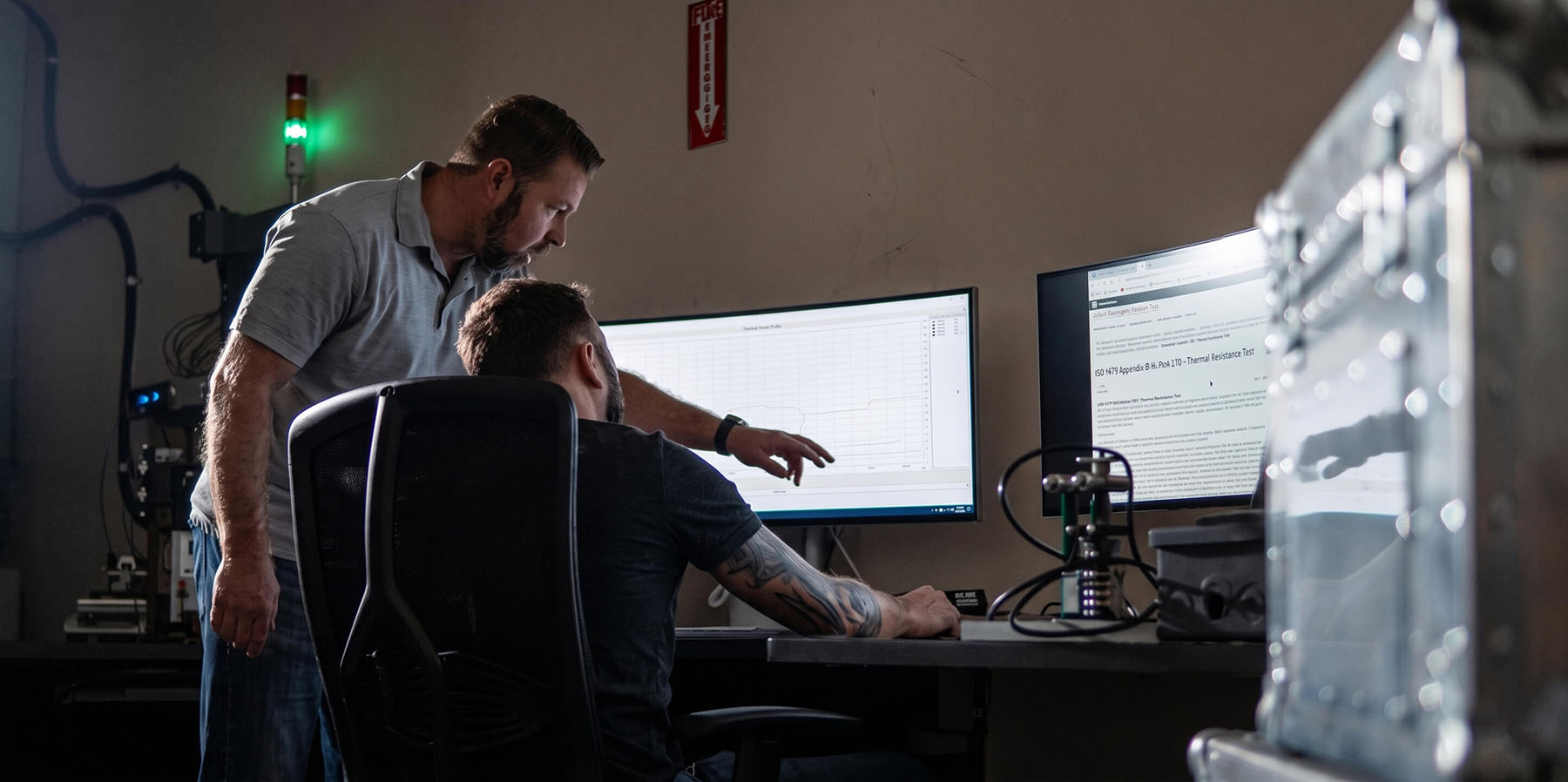
Americase’s In-House Testing Laboratory
Every Americase container is tested to perform when it matters most.
Our comprehensive testing process simulates real-world conditions and use scenarios—analyzing impacts, heat, moisture exposure, vibrations, and more—to confirm the safety and efficacy of our shipping and storage containers. Our team of test engineers tailors testing strategies to address your specific needs, ensuring that your packaging solutions meet or surpass safety regulations, industry certifications, and performance requirements.
Our testing capabilities include:
- Performance Packaging Certification
- Stack Test – 49CFR 178.606, 178.980 (Large Format)
- Drop Test – 49CFR 178.603, 178.965 (Large Format)
- See Drop Test for Helicopter Blade Cases
- Cobb Test – 49CFR 178.516 / ISO 535
- Bottom Lift Test – 49CFR 178.170 (Large Format)
- Top Lift Test – 49CFR 178.175 (Large Format)
- Thermal Resistance Test – 49CFR Part 178 Appendix D
- Puncture Testing
- Shock and Fragility Testing
- All of the above to include accelerometers and give results relative to G Forces
- Flat Drop Testing
- Rotational Drop Testing
- Edge Drop Testing
- Corner Drop Testing
- Impact Testing
- Flame and Thermal Resistance Testing
- Thermal Runaway Containment Test – Portions of 9540A, AS6413
- See Thermal Runaway and Containment Test for Consumer Electronics Recall Packaging
- See Thermal Runaway and Containment Test demonstration of Battery Backup Unit (BBU) Container
- UN 38.3 Standard Test
- Fuel-Soaked Rag Test
- Environmental Testing
- Compression and Torsion Static and Dynamic Testing
- Rainwater Testing – ATSM D951
- ESD Testing – ANSI / ESD STM 11.11
- Surface Resistance Testing – ANSI / ESD STM 11.11
- All tests listed above are customizable with or without guidance from a specific standard.
- Please note that the above is not an exhaustive list but rather a list of the most frequently requested and performed tests. We are testing experts with proven capability and experience to develop and execute custom testing plans.
Data Driven Processes for Safer Lithium-Ion Packaging
Americase draws on decades of test data spanning flammability, projectile risk, and fume toxicity to engineer packaging with enhanced safety margins. Our process also anticipates emerging battery chemistries, incorporating comprehensive testing to establish containment requirements before risks materialize in transportation or storage.
Through rapid prototyping and continuous improvement, we capture testing insights into a living database that powers future simulations without repeating destructive tests. It’s a smarter approach to protective packaging innovation, and a direct reflection of our commitment to safer hazmat shipping and storage.
Your mission-critical challenge deserves
mission-critical expertise.